Companies House and HMRC are not the same thing: what new directors need to file, and where
A practical guide to the separate Companies House and HMRC obligations new directors need to understand, and why telling one does not automatically tell the other.
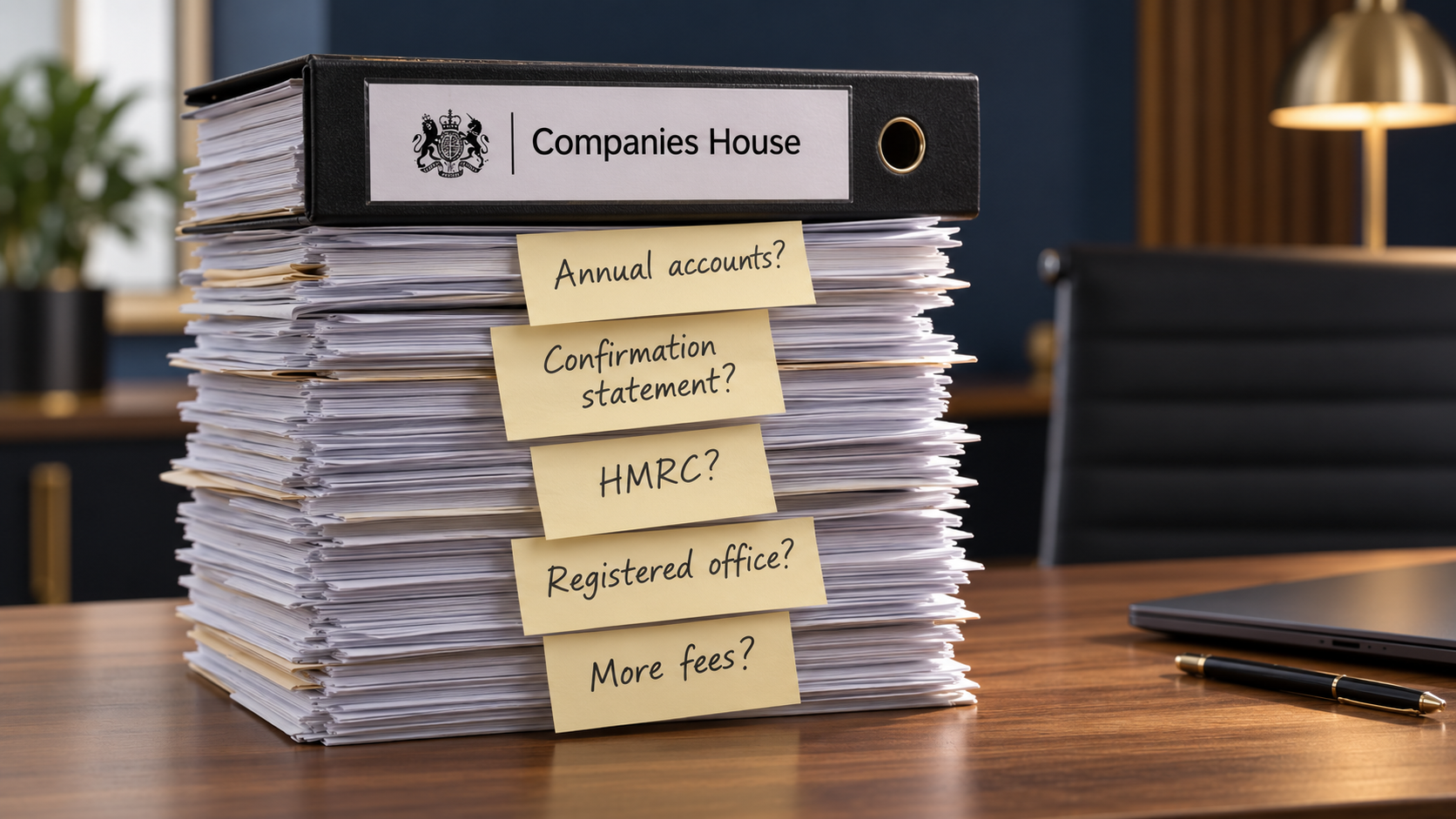
Setting up a limited company is remarkably easy. Running one properly involves rather more.
One of the most common sources of confusion for new directors is that Companies House and HM Revenue & Customs are separate organisations with separate functions, separate filing systems and separate deadlines. Telling one of them something does not necessarily tell the other.
That sounds obvious once it is said out loud. In practice, it is a surprisingly common source of missed filings, penalties and confusion, particularly where a founder assumes that incorporation, an accountant or a single government login has somehow joined the whole process together.
What goes to Companies House?
Companies House is concerned principally with the company as a registered legal entity and with the information held on the public register.
For a straightforward private limited company, that usually means dealing with matters such as annual accounts, the confirmation statement, changes to directors or the registered office, information about people with significant control, share capital and other corporate changes which have to be recorded.
The confirmation statement is not the company's tax return. It is an annual check that the information held by Companies House is complete and up to date. A company must normally file at least one confirmation statement in every twelve-month review period even if nothing has changed. Annual accounts are a separate Companies House obligation and remain relevant even where a company is dormant, although the form of the accounts may be simpler.
For new companies, the first accounts timetable can also catch directors out because the first accounting period does not necessarily look like a neat twelve-month year. The safest approach is to check the company's own filing dates on the register rather than assume that every deadline falls on the anniversary of incorporation.
So what goes to HMRC?
HMRC is principally concerned with taxation. Depending on what the company is doing, that can include Corporation Tax, the Company Tax Return, PAYE if the company employs people or pays directors through payroll, VAT where the business is registered or required to register, and other tax-specific reporting.
A Company Tax Return is not the same thing as filing the company's accounts at Companies House. The same set of accounts may be used as part of the tax process, and some software can submit information to both organisations, but the legal obligations and deadlines remain separate.
That distinction matters particularly in the first year. A new director can quite reasonably believe that because accounts have been filed with Companies House the tax position has also been dealt with, or that because HMRC has been told the company is not trading nothing further is required at Companies House. Neither assumption is safe.
PAYE and VAT create further layers. Closing payroll does not close the company. Cancelling a VAT registration does not tell Companies House that the company is dormant. The right question is not simply “have we told the government?” but “which organisation needed to know this, and has the correct filing or notification actually been made?”
“My accountant deals with all of that”
Perhaps. But check.
It is entirely normal for an accountant, bookkeeper, formation agent or other adviser to make filings on a company's behalf. The important point is to understand the scope of what they have actually agreed to do. An accountant preparing year-end accounts may not be responsible for maintaining the Companies House register. A bookkeeper running payroll may not be dealing with Corporation Tax. A company-formation service may have incorporated the company and done nothing further.
The director remains legally responsible for ensuring that the company meets its obligations even where somebody else has been instructed to handle the administration. That does not mean an adviser can never be at fault. Advisers can miss deadlines, misunderstand instructions or fail to do work they agreed to undertake. It does mean that “I thought the accountant was doing it” is a risky system of governance.
A simple responsibility list is often enough: who is filing the accounts, who is dealing with the Company Tax Return, who monitors the confirmation statement, who deals with payroll and VAT, and who actually reads correspondence sent to the registered office and registered email address?
When illness, incapacity or death intervenes
These arrangements become much more important when something happens to the person who ordinarily dealt with the company.
Serious illness, incapacity or a death can explain why a filing was missed and may be relevant to an appeal against a penalty in the right circumstances. They do not automatically make the company's deadlines disappear. If a sole director becomes unable to deal with the company, or dies, the company itself does not simply vanish. Its records, accounts, tax position, assets and liabilities still need to be dealt with, while the route to appointing somebody able to act may depend on the company's articles, shareholding and the authority of personal representatives.
This is where a business that has always operated informally can suddenly become very difficult to administer. Passwords are unknown, the accountant is waiting for instructions, Companies House correspondence is going to an old address, HMRC has a different contact record, and nobody is entirely sure which filings were actually completed.
It is much easier to prevent that problem than to reconstruct it afterwards. At minimum, another appropriate person should know who the advisers are, where the core records are held and how important filing dates are monitored.
Telling one organisation does not necessarily tell the other
Changing information at Companies House does not mean that every HMRC record, payroll scheme, VAT registration, bank mandate or third-party record has automatically been updated. Likewise, dealing with HMRC does not necessarily update the public Companies House register.
There are some services and software products which can submit information to more than one destination, but that is a feature of the service being used, not a general rule that all government systems share every update.
The practical discipline is therefore quite simple: identify the event, identify every organisation that needs to know about it, and confirm that each required filing or notification has actually been completed.
What if things have already gone wrong?
The first task is usually reconstruction.
Work out what the company has done, when it started or stopped trading, which accounts and returns were due, what has actually been filed, what correspondence has been received, what penalties have been issued and which adviser was responsible for which piece of work. Download the Companies House filing history, gather HMRC notices and account records, and compare them against the company's own records rather than relying on recollection.
From there, the problem normally becomes much more manageable. Missing filings can be identified, incorrect assumptions can be separated from genuine adviser failures, penalties can be considered on their own facts, and the company can decide whether it is trading, dormant or should be closed properly.
Aubrey International can assist directors where the administrative history has become blurred, particularly where responsibilities between directors and advisers are disputed, filings have been missed, or illness, death or a period of inactivity has left nobody with a reliable picture of what happened. Where the issue requires specialist tax or accountancy work, we work alongside or identify an appropriately qualified adviser rather than treating legal and tax obligations as interchangeable.
Information note: This article provides general information and practical context for companies in England and Wales. It is not legal, tax or accountancy advice on an individual matter. Tax and accountancy questions should be checked with an appropriately qualified adviser.
 Practical support. Real solutions.
Related insights
Business & CompanyYou incorporated too early. Now the admin is becoming a burden: what should you do?
 Business & Company
Dormant does not mean forgotten: what responsibilities remain when your company is not trading?
 Business & Company
You’ve formed a limited company. What have you actually signed up for?
When the issue is live, context matters.
Aubrey International supports employers and businesses with sensitive employment, commercial and regulatory matters where an independent view or practical additional support is needed.